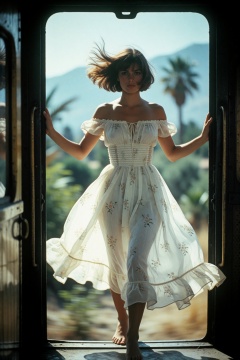
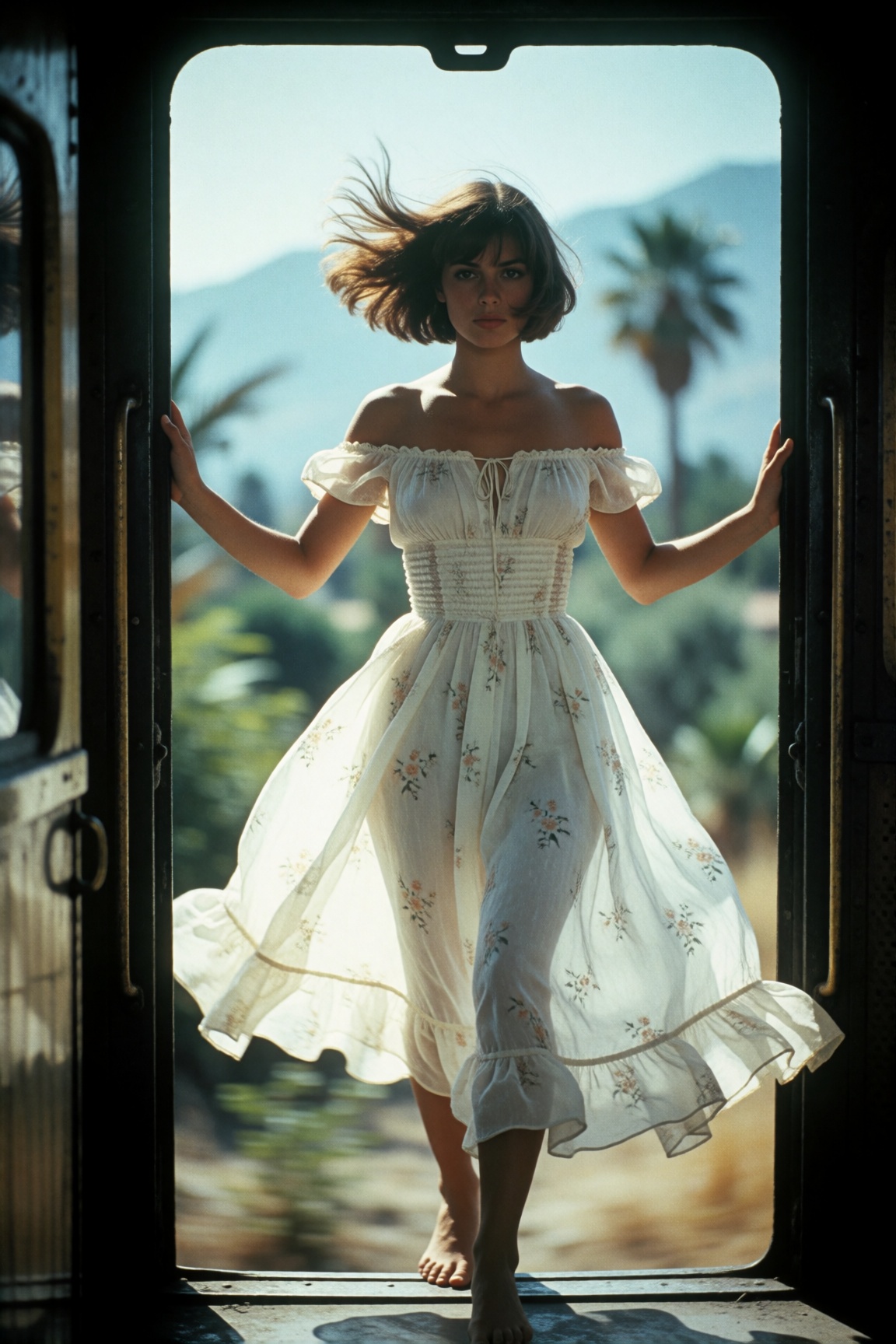
A full-frame 35mm analogue photograph, in the style of 1920s European cinema. The camera utilized is a vintage SLR with a 200mm prime telephoto lens, creating a significant compression effect that flattens the depth of field, indistinct blur while rendering the foreground with sharp, painful clarity. The image is bathed in the authentic texture of Kodak Ektachrome film, characterized by heavy grain, a subtle color shift, and a subtle vignette on the edges of the frame.
Functioning as an authentic 1970s directed film classic still shot, the scene is powerfully framed by the stark, heavily shadowed vertical lines of an open train carriage doorway, creating a voyeuristic frame-within-a-frame. Standing boldly on the metal threshold is a young woman, facing the lens directly. She is barefoot, stepping delicately yet firmly onto the edge. Her arms are extended outward, her hands gripping the dark edges of the sliding doors to steady herself against the rhythmic motion of the journey. She wears a light, flowing, off-the-shoulder white peasant dress adorned with a delicate, sparse floral motif, a ruched bodice, and a ruffled hem.
The intense kinetic energy of the moving train is captured in a dramatic freeze-frame: a fierce wind whips her chic, chin-length brown bob straight up and back from her face, while aggressively billowing the sheer, light fabric of her skirt into a wide bell shape around her legs. Despite the chaotic wind and the danger of the open door, her expression remains profoundly serene and confident, her gaze fixed directly on the viewer with a quiet, enigmatic intensity. The optical compression of the telephoto lens pulls the violently blurred background forward—a sun-drenched, hazy landscape of passing palm trees, lush green foliage, and distant faded blue mountains under a stark, clear sky.
Director's influence: François Truffaut, emphasizing spirited, kinetic romanticism, striking natural light, naturalistic styling, and the cinematic framing of a fleeting, deeply liberated moment in time.