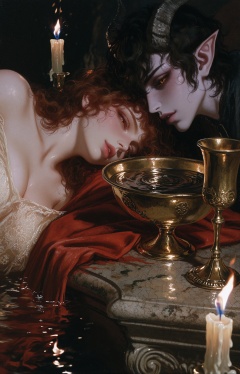
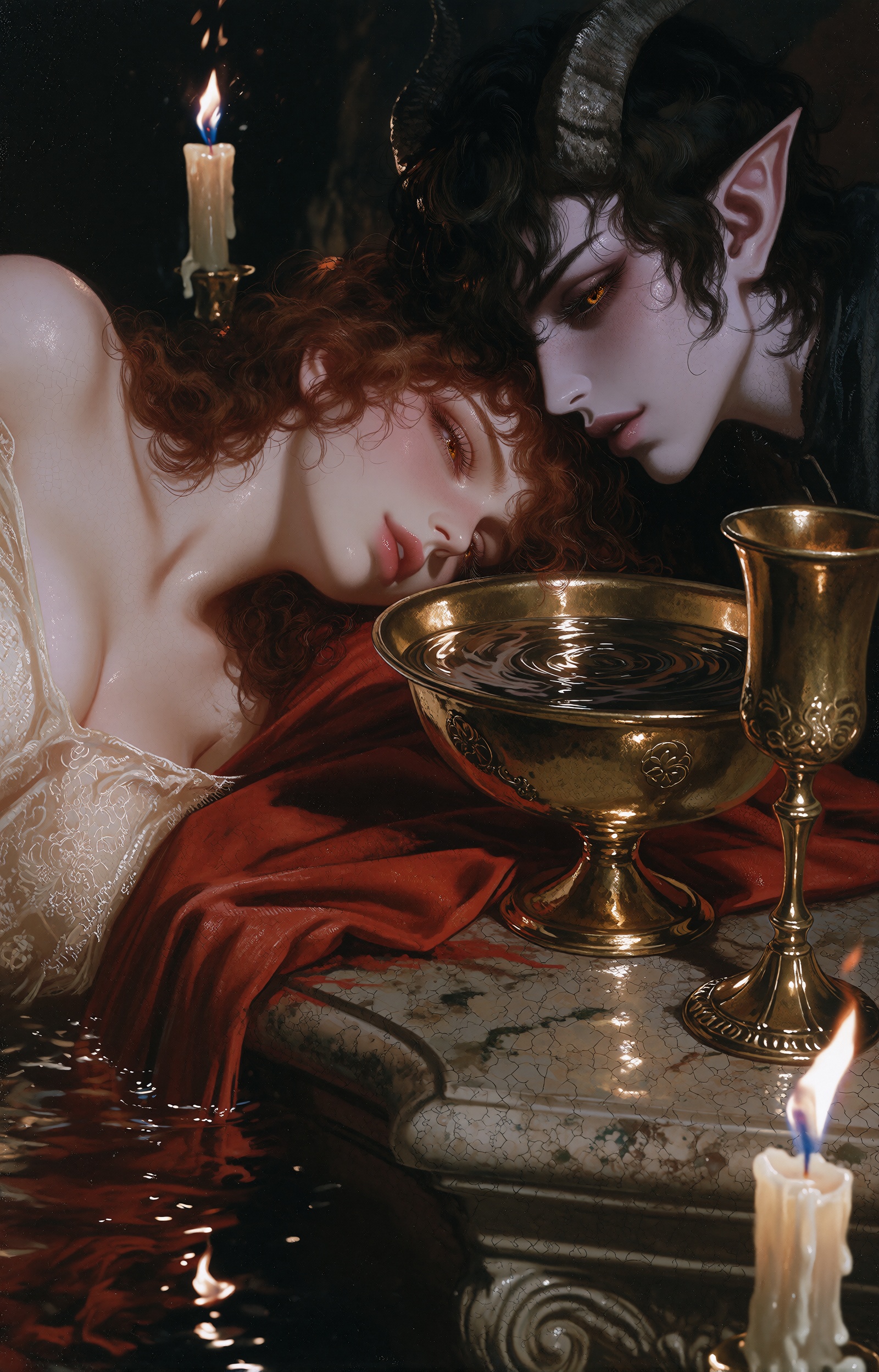
Two figures share an intimate, menacing closeness inside a dreaming darkness: a young woman with curly auburn hair rests her tilted head upon a vermilion cloth, her bare ivory shoulder emerging from a slipping cream lace garment, eyes open and glancing sideways in melancholy resignation; behind her a horned dream-demon with pale lilac-grey skin, dark curly hair, small curved horns and pointed ears leans until its face nearly touches her hair, amber-yellow eyes heavy-lidded and watchful, whispering toward the rim of a polished golden bowl.
They inhabit a vast candle-lit void: a mottled stone parapet carries the draped red cloth and a great brass bowl beside a taller golden goblet, while a single small candle flame hangs in the upper darkness with no candle beneath it. Dream logic seeps in — the bowl holds swirling night instead of a reflection, the red cloth flows past the ledge like slow liquid, and faint duplicate flames drift like embers underwater. Warm candle glow models the woman's porcelain flesh and the gold's mirror highlights, cooler pale light settles on the demon's face, and deep black shadow swallows every edge.
The composition is an intimate close-up on a diagonal axis from the woman's resting head at lower left to the demon's hovering head at upper right, with shallow painterly depth of field and edges dissolving into darkness. The rendering fuses symbolist academic oil painting with dreamcore surrealism: fine craquelure and aged varnish beneath luminous glazes, smooth porcelain skin finish, mirror-polished metal reflections, saturated vermilion and gold against near-black, dreamlike soft focus, nostalgic dread, extremely detailed painterly surface, museum-grade hyper-aesthetic finish.