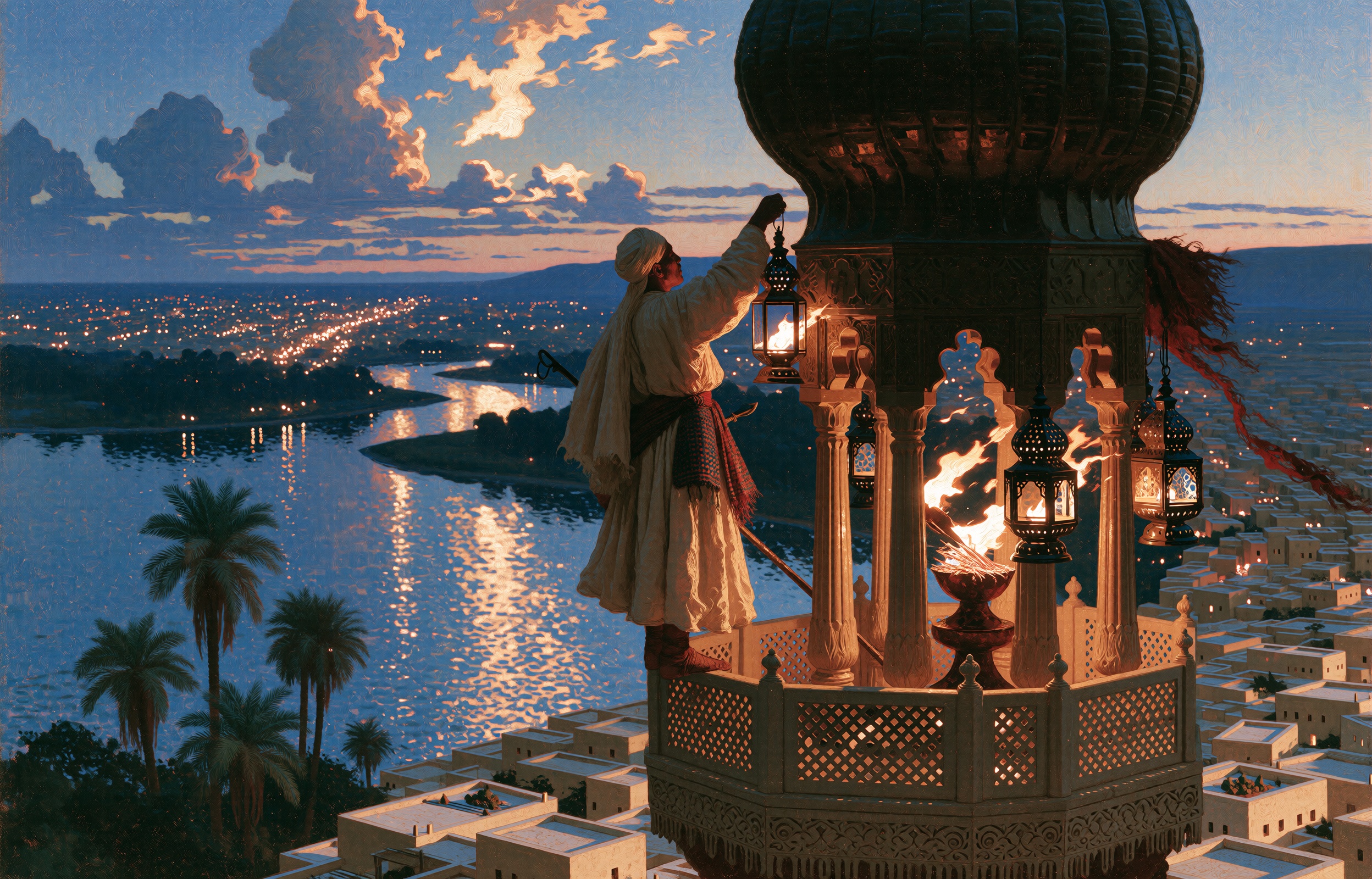
At the blue hour of dusk, a robed lamplighter balances on the carved balustrade of a high balcony, reaching up to hang the evening's first lantern beneath a columned kiosk crowned by a great dark onion dome. He is the hour-keeper: when this flame catches, the city below is permitted to dream. Pierced-metal lanterns already glow amber between the columns, casting lacework light on warm stone, while his cream robe and woven sash stir in the river breeze. Far below, a winding river mirrors the graded sky — cerulean fading through pale gold to rose — threading palm groves and a distant city igniting its lights, as cream flat-roofed houses cascade down the slope. Golden-hour light rims the figure from the left, and the kindling flame answers it point for point. The composition is vertical and reverent, slightly low-angled, deep-focused on the ritual while painterly atmosphere softens the river valley. Rendered as a golden-age painterly illustration elevated to luminous tempera with varnish glow — orientalist classicism in a dusk gradient of cerulean, pale gold, and rose against amber flame, smooth brushwork and fine canvas grain, its Nile-side Mughal-inspired architecture treated with quiet dignity.