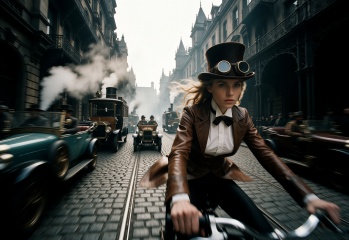
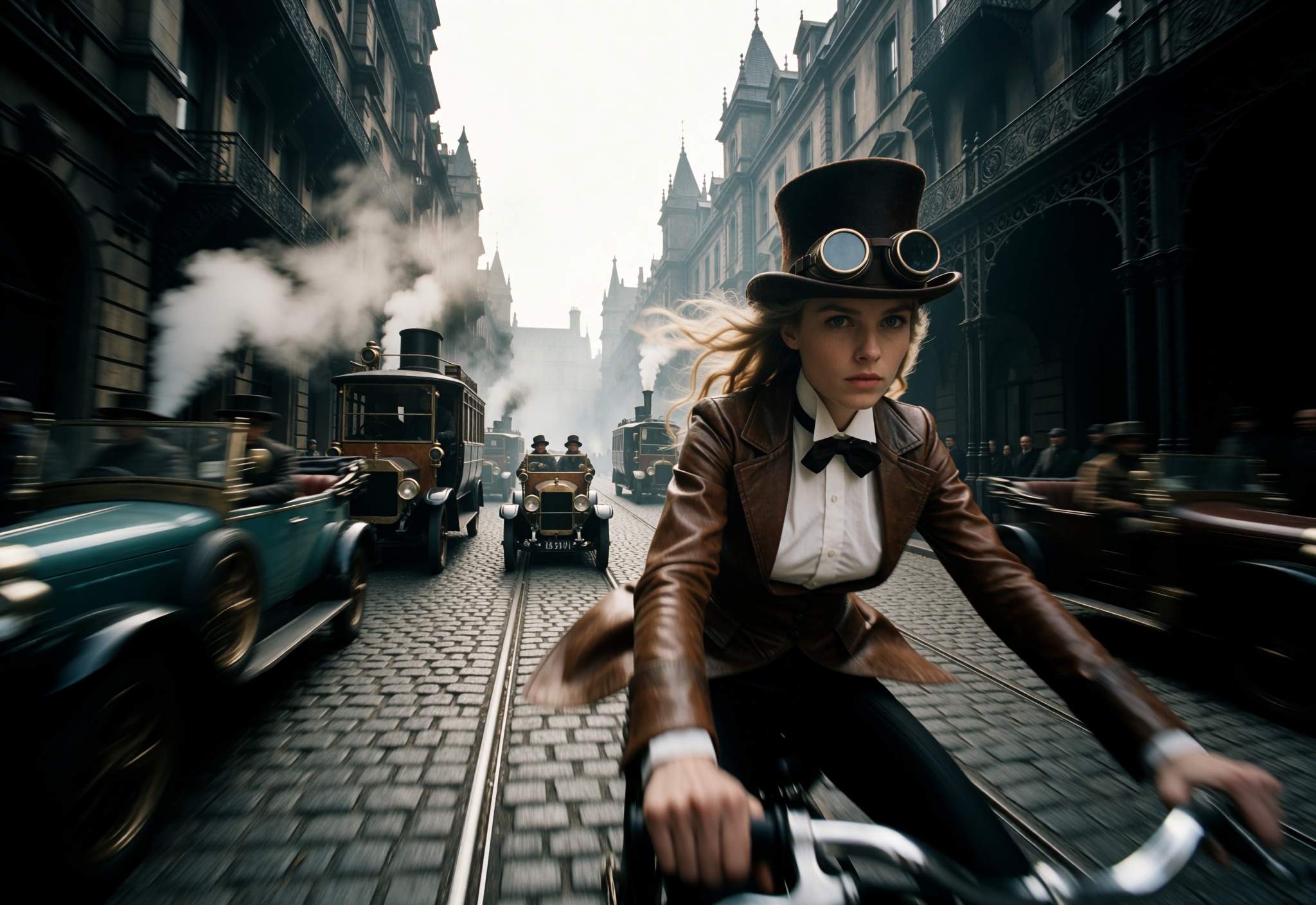
While the towering architecture might suggest an epic scale often captured from above, to label this an "aerial shot" would be to miss its breathtaking, street-level immediacy. This is not a view from the heavens; this is a plunge into the heart of the action. What you are witnessing is an audacious and almost mythical on-set photograph, an authentic 1990s analogue masterpiece from the production of *The Alchemist's Overture*, a hugely ambitious but famously-shelved steampunk thriller from 1998. This single, extraordinary frame is the result of a revolutionary and notoriously difficult photographic technique, making it one of the most sought-after and enigmatic images of late-20th-century film photography.
The first, most striking aspect that defies belief is its painterly quality. This is no mistake or flaw. The photographer, a maverick artist known for his boundary-pushing darkroom work, didn't simply shoot on film; he printed on it. This image is the result of a painstaking and rare gum bichromate process, combined with a liquid emulsion lift onto heavy, textured watercolor paper. He shot the scene on a large format 4x5 Graflex camera using a sheet of high-contrast Ilford Ortho Plus film to capture the incredible depth of detail. In the darkroom, the negative was then used to create a multi-layered print. This process is what gives the image its unique, non-photographic texture—the soft bleed of the sky, the granular quality of the cobblestones, and the way the edges of the frame seem to dissolve into the white of the paper. It is the pinnacle of analogue artistry, a "realistic" scene rendered with the soul of a watercolor, a hallmark of the experimental, high-concept visual styles that thrived in 90s independent cinema.
The cinematic brilliance of the composition is immediately apparent. The photographer has chosen a low angle, placing us right on the chaotic street, looking up slightly at our heroine. The street, packed with a fantastic mix of early 20th-century automobiles and belching steam, functions as a canyon, the towering, soot-stained buildings creating powerful leading lines that converge in the hazy distance. This creates a graphic sense of both claustrophobia and forward momentum. The entire scene is electric with motion blur. This is not a digital effect; this is the authentic result of a deliberately slow shutter speed. The wisps of her blonde hair, caught in the wind of her passage, are soft streaks of light. The steam puffing from the vehicle on the left is a soft, ethereal cloud, and the cobblestones in the immediate foreground are blurred with a kinetic rush, pulling us into the frame alongside her.
And at the heart of this dramatic scene is the rider, an unforgettable vision of rebellious beauty. She was portrayed by a promising young British actress, then in her early twenties, known for her sharp intelligence and athletic grace. Her character, a brilliant inventor and dispatch rider for a revolutionary movement, is perfectly embodied in her look. She is strikingly slender, her figure both skinny and slim, showcased by the exquisitely tailored brown leather riding jacket cinched at her waist. Yet, her confident grip on the handlebars and the poised, alert set of her shoulders suggest a toned, powerful physique—a body honed for action and speed. The crisp white shirt, peeking out from under her jacket and adorned with a prim bowtie, is pulled taut across a generous bust, creating an eye-catching contrast between masculine-coded adventure gear and an undeniably feminine form. Her beauty is luminous yet defiant, with sharp, intelligent features and a determined gaze that meets the camera, and the viewer, head-on. She is not just in the scene; she is commanding it.
The use of bokeh is subtle and masterful, a testament to the large format camera. The critical plane of focus is locked perfectly on her face and the intricate details of her top-hat and goggles. From there, the focus falls off beautifully. The early motorcar to her left is still sharp but beginning to soften, while the vehicles further down the street dissolve into impressionistic shapes. The ornate ironwork and stone facades of the buildings recede into an atmospheric haze. This is authentic 90s bokeh: a tool for narrative separation, isolating our heroine from the chaos she navigates, making her the undeniable anchor of the entire epic composition.
The historical accuracy of this period piece is a marvel of production design, creating a believable world that is both familiar and fantastical. This is the core of the 90s steampunk thriller aesthetic: not a slavish recreation of the past, but a plausible, reimagined version of it. The anachronism of the gleaming teal Vespa, a symbol of mid-century freedom, dropped into a world of Victorian/Edwardian technology, is the central, thrilling visual conceit. The incredible depth of detail captured by the large format film makes it all feel real—the wear on the cobblestones, the metallic sheen of the tram tracks, the precise engineering of the goggles on her hat, the authentic grime on the chassis of the cars. It all contributes to a powerful sense of suspense. She is clearly on a mission, a vital cog in a larger thriller plot, and this single, perfect photograph captures the most dynamic moment of her journey. It is an image that is both epic and intimate, a testament to a time when cinematic brilliance was measured in the daring chemistry of the darkroom, not the processing power of a computer.