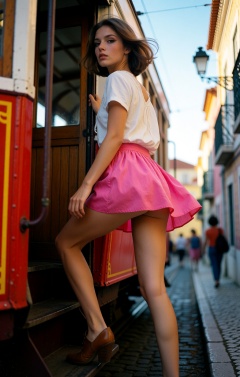
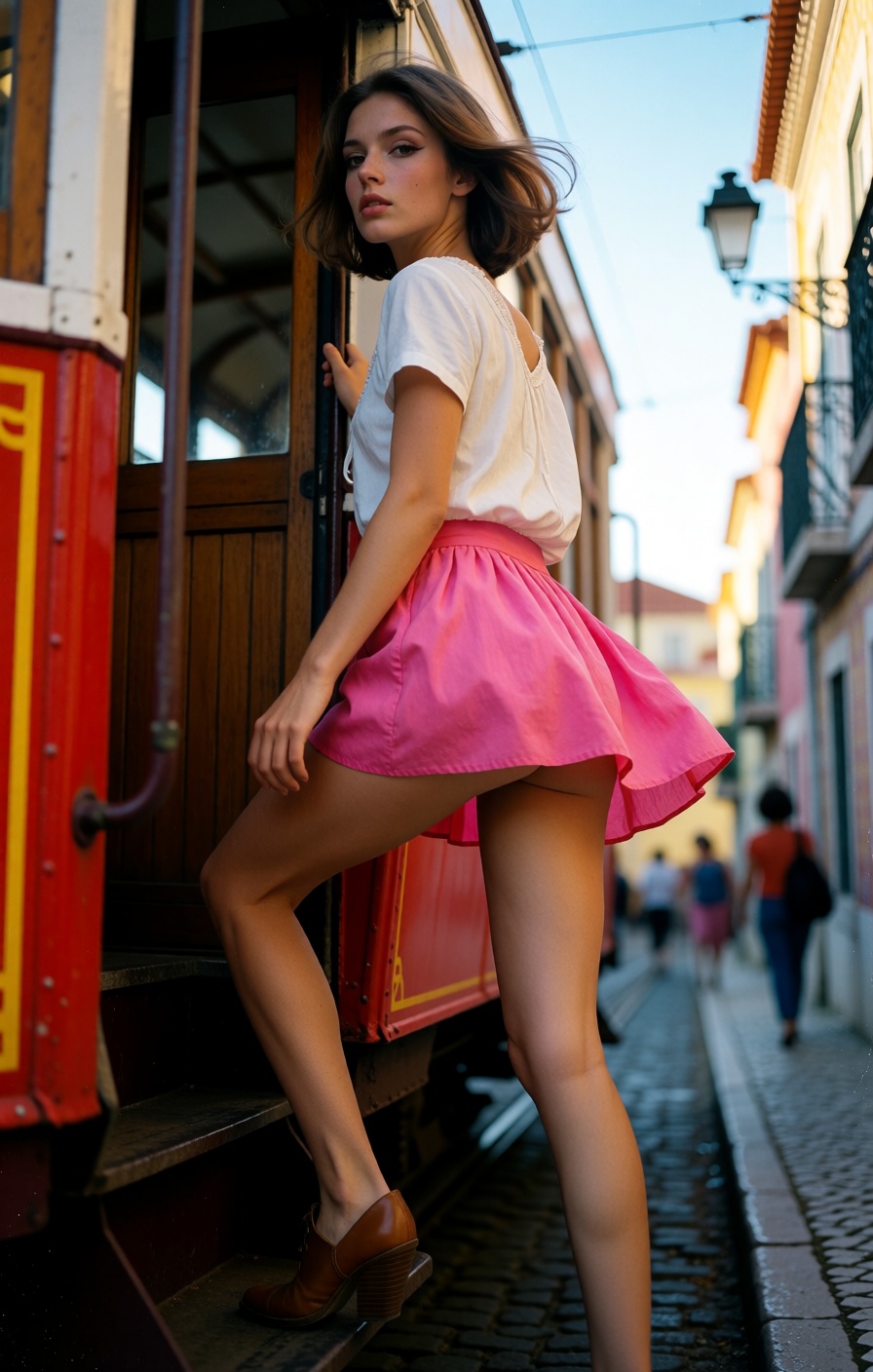
The image depicts a captivating scene of a young woman, seemingly in her early twenties, ascending the steps of Lisbon's legendary tram number 10. Her youthful appearance and impossibly slim, doll-like figure are quintessential of the era's fashion and beauty standards. She exudes a carefree and self-assured aura, characteristic of the liberated spirit of the 1970s.
The woman's facial features are delicate, with high cheekbones, a petite nose, and full lips that curve into a determined expression. Her hair is styled in a fashionable, chin-length bob with subtle layers, framing her heart-shaped face. A few loose strands are swept back, revealing her forehead, as she gazes ahead with a resolute look. Her eyes, accentuated with a swipe of eyeliner and a coat of mascara, sparkle with a sense of adventure.
She wears a vibrant, mini skirt that falls just above the midpoint of her thighs, showcasing her impossibly long legs. The skirt's fabric appears lightweight, billowing in the wind as she moves, and adding a touch of provocativeness to the scene. The garment's color is a bright, poppy pink, which complements her white, short-sleeved blouse with a relaxed fit and a delicate lace trim along the neckline. A pair of low-heeled, brown ankle boots with a stacked heel and pointed toes adds a touch of practicality to her outfit.
The photograph is taken from a position behind and slightly to the side of the subject, emphasizing the curves of her buttocks and legs as she ascends the tram's steps. The angle, combined with the use of a telephoto lens, creates a compressed perspective, making objects appear closer together than they are in reality. The lens's shallow depth of field results in a subtle blur, with the woman's face and body remaining relatively sharp, while the surrounding environment is softly focused.
The scene unfolds against the vibrant backdrop of Lisbon's historic neighborhood, with its colorful, tile-covered houses, ornate ironwork, and cobblestone alleys. The iconic, red tram number 10, with its wooden slats and ornate metalwork, provides a striking contrast to the subject's movement. The tram's doors, slightly ajar, and the pedestrians in the distance, contribute to the sense of motion and life in the scene.
The color palette features a mix of warm and cool tones, with the subject's bright attire and the red tram adding to the image's freshness and movement. The vivid, contrasting light of the city, likely captured during the golden hour, adds to the overall sense of energy and vitality. The warm tones of the buildings and the cool tones of the sky create a sense of depth, drawing the viewer's eye into the scene.
The woman's pose embodies a sense of dynamism and confidence, as she boards the moving tram. Her legs are stretched, and her body is balanced for stability, with one hand grasping the doorframe and the other holding her skirt in place. Her posture exudes a sense of determination and excitement, inviting the viewer to partake in the exhilaration of navigating the narrow streets of Lisbon.
The photograph's grain and texture suggest an analogue camera, likely a high-quality film camera, given the level of detail and the controlled blur. The image's aesthetic is reminiscent of the era's ******* photography, with a subtle, nostalgic quality that transports the viewer to a bygone era. The lack of digital enhancements and the presence of minor film grain add to the image's authenticity, making it appear as if it was captured on a roll of film.
The photographer's objective was to capture this transient moment in time, distilling the essence of the experience and the subject's vivacity into a single, captivating frame. The result is an image that not only freezes a moment in time but also invites the viewer to immerse themselves in the energy and spirit of the scene. The photograph, in every way, embodies the carefree and adventurous essence of the 1970s, with its liberated fashion, vibrant colors, and dynamic composition.
The image resolution appears to be grainy with scan lines faintly visible suggestive of it originating from a film negative and was possibly captured on 35mm film and printed on photographic paper to produce a tactile texture with minor imperfections visible on its surface.
Every element in the photograph exudes a vivid sense of movement and youthful exuberance making it a thrilling and memorable image. The dynamic atmosphere and the woman's spirited demeanor combine to evoke the feeling of experiencing a lost moment preserved through the photograph capturing it much like Proust’s Madeleine cake providing a tangible key back to relive specific sights.