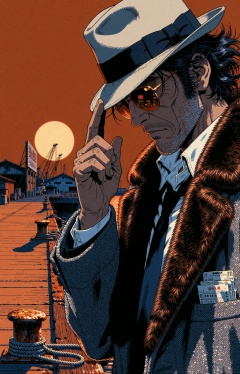
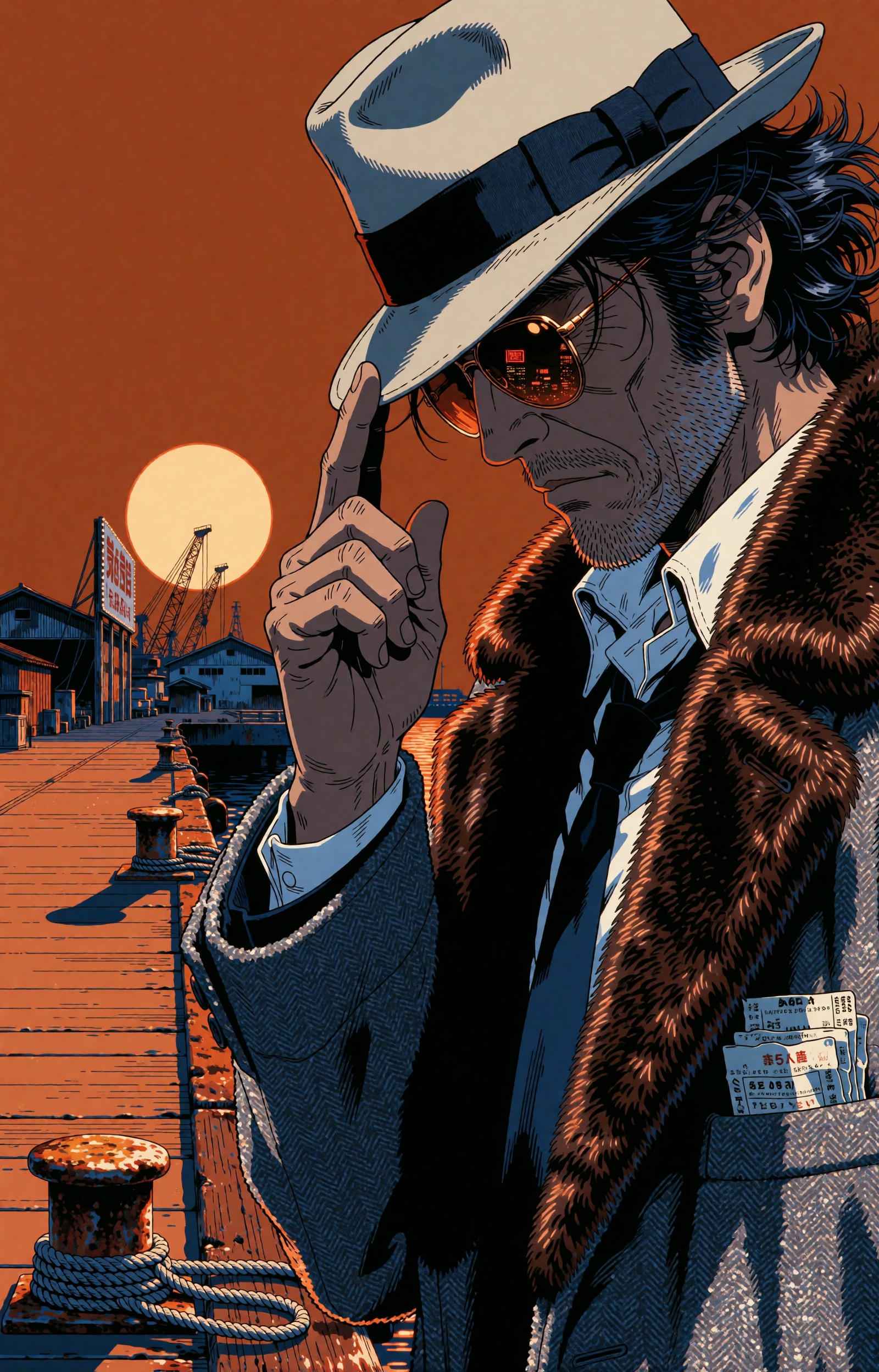
SUBJECT: A weathered man in his late forties stands as the **** figure, his identity half-hidden beneath the brim of a cream fedora. Unkempt dark hair escapes from under the hat band, and salt-pepper stubble clings to his jaw. He carries the stillness of someone who has stopped running but has not finished being chased. His presence dominates the frame the way a rumor dominates a small harbor town.
ATTIRE: He wears a heavy wool overcoat with a deep brown fur collar turned up against the evening wind. Beneath it, a crisp white shirt and a loosely knotted dark tie suggest a ceremony he no longer respects. The cream fedora bears a plain black band, tilted to shade eyes that already shade themselves. Amber-tinted aviator sunglasses complete the disguise of a man who prefers to be seen but not read.
ACTION/POSE: He is caught mid-gesture, two fingers raised to the brim of his hat in a courtesy that could be greeting or farewell. His body angles away in strict profile while his attention remains fixed beyond the frame. The pose is unhurried, almost ceremonial, as if the gesture were a sentence rehearsed for years.
EXPRESSION/MICRO ACTION: His mouth is set in a flat, unreadable line beneath the stubble, neither threat nor welcome. A faint tension at the corner of his jaw betrays calculation behind the calm. Within the amber lenses a faint reflection of a neon city glows — the city behind the camera, the one he is turning his back on.
ENVIRONMENT: Behind him stretches a harbor pier at dusk, its wooden planks and rusted bollards simplified into flat shapes by the dying light. The sky is an uninterrupted field of saturated burnt orange, unnaturally even, as if the world were printed rather than lit. A perfect circular sun of pale yellow hangs low behind the cranes of the distant port, motionless as a logo stamped on paper. Silhouetted warehouse roofs and a single painted marquee board with worn, illegible lettering anchor the scene to a working waterfront.
LIGHTING: The warm world and the cool figure refuse to share a light source: he remains bathed in cold blue duotone while everything around him glows amber. A low raking light from the paper-disc sun edges his fur collar and hat brim with a thin warm rim. His shadow falls incorrectly blue across the orange planks, marking him as a stranger to the physics of this heaven.
CAMERA/COMPOSITION: A medium close profile shot places him on the right third of the frame, leaving the left two-thirds to the flat orange field and the stamped sun. The camera sits at eye level with a slight downward tilt toward his gesture, echoing classic crime-poster blocking. Depth is deliberately compressed so that figure, pier, and sky read as layered planes of silkscreen ink.
AESTHETICS: The image fuses 1970s Showa-era crime-film noir with contemporary silkscreen poster design. Photographic texture on the figure collides with graphic flatness in the background, producing a living poster rather than a photograph. Bold negative space, hard plane separation, and restrained grain give it the confidence of vintage theatrical key art.
PROPS: A creased ferry ticket peeks from his overcoat pocket, folded and refolded until the print has gone soft. A coiled mooring rope around the bollard at his side is the only other object allowed to share his plane.
MATERIAL/TEXTURE: The fur collar reads as dense, slightly matted strands catching the rim light individually. The wool coat shows a coarse weave dusted with salt air, while the shirt keeps an unnatural paper crispness. The background planes carry the tooth of screen-printed ink, with faint misregistration where blue meets orange.
COLOR PALETTE: The palette is a strict duotone-plus-one: cold cyan-blue for the figure, burnt orange for the world, a single disc of pale yellow for the sun. Amber lenses and the brown fur collar provide the only intermediate tones, hinges between the two temperature regimes. No other hue is permitted to enter the frame.
MOOD: Courteous menace wrapped in melancholy nostalgia — a farewell performed with perfect manners by a man who intends to remain a stranger. There is warmth in the world and none in him, and the gap between them is the entire story.
STYLE REFERENCE: Anchored in 1970s Japanese yakuza-film theatrical posters, silkscreen crime key art, and the duotone grammar of modern crime-game marketing, with photographic figure treatment in the manner of classic noir stills.