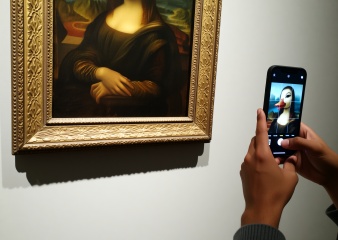
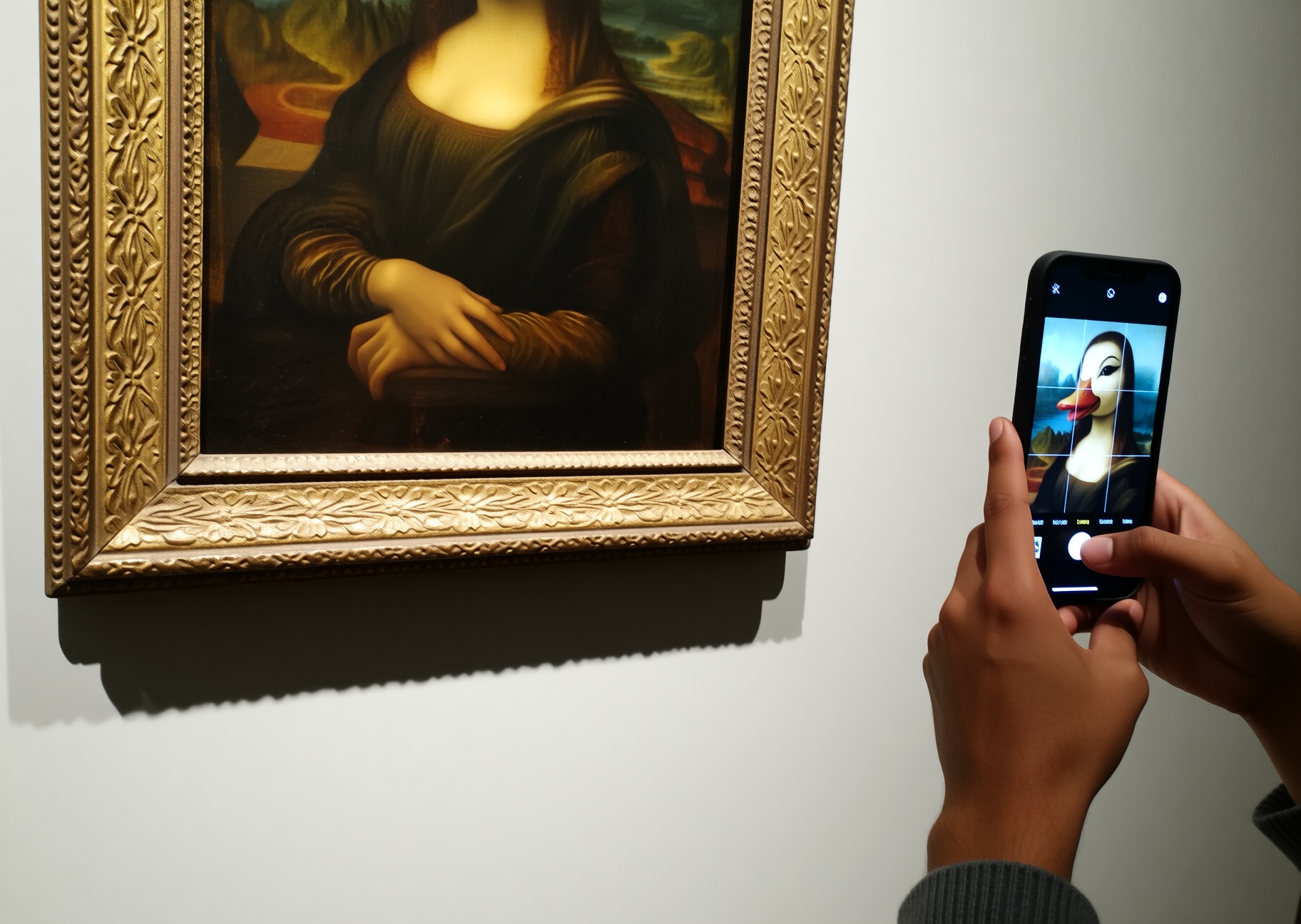
An oil painting of a Duck posed as the Mona Lisa in a thick ornate carved gold frame hanging on a plain pale grey gallery wall, filling the left two-thirds of the frame, dark veil, folded hands, muted olive, umber and ochre sfumato, fine craquelure and visible brushwork under yellowed varnish, a black inner liner inside the gilded molding, the frame tipped at a slight angle and casting a hard dark shadow down and to the left across the wall. To the right a pair of brown-skinned hands hold a black smartphone upright in portrait orientation, aimed at the canvas, a grey knit sleeve and bare forearm entering from the bottom right corner. The phone's camera app is open, its screen glowing cool blue-white, thin white gridlines and a gold focus rectangle framing a thumbnail of the painting — but the Duck on the screen is a different version: the same Duck with torso showing, heavy black winged eyeliner, glossy red lips and her tongue sticking out, painted in the same Renaissance oil style. Shot at a slight low three-quarter angle, medium-wide framing, sharp focus on the phone and hands, the painting marginally softer, a large patch of empty wall below. Soft diffuse overhead museum light, warm gold highlights running along the frame molding, a cool blue cast from the screen on her fingertips, muted beige and grey palette. Casual handheld iPhone snapshot, mild sensor noise, natural color.