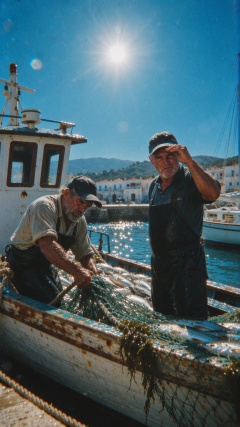
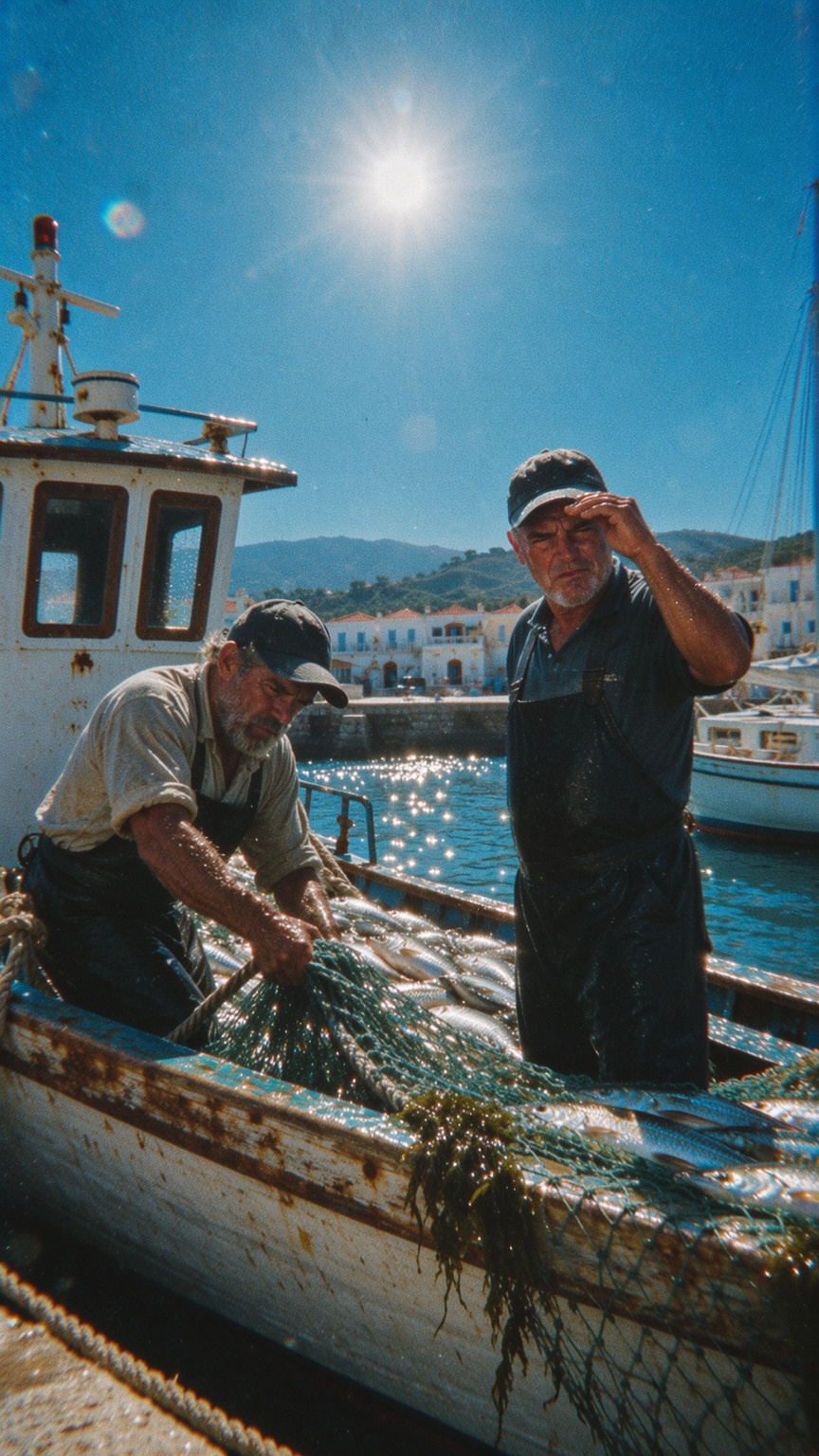
A documentary photograph made at solar noon in a small Mediterranean fishing harbour, shot on a full-frame body with a 28mm lens at f/8, ISO 100, 1/1250s. The sun is almost directly overhead and is the only light source, so every shadow is short, hard-edged and falls straight down: deep black shadows inside eye sockets, under the brim of a cap, beneath the chin and behind the wheelhouse of the nearest boat. Two fishermen in their fifties and sixties work on a moored wooden skiff, one leaning over the gunwale hauling a wet net, the other standing squinting into the light with one hand raised to his brow. Both men squint genuinely and their faces are half-lost in shadow under their caps.
The light behaves correctly for direct sun. Wet rope and fish scales throw small blown-out specular highlights with no soft falloff. White painted hulls clip to pure white on their sun-facing planes while their shaded sides drop to a cool reflected blue from the water. The sky is a dense cyan with a slight haze near the horizon, and the top corners show faint natural vignetting from the wide lens. There is mild veiling flare and a small polygonal ghost near the upper left where the sun just misses the frame edge, plus visible chromatic aberration on the high-contrast rigging at the extreme corners. Heat shimmer distorts the far quay very slightly.
Deep depth of field from about two metres to infinity, with sharp focus across both men and the boat. Every surface reads as unretouched: sun-bleached and salt-pitted wood, flaking blue paint, rust stains around bolt heads, coarse nylon netting with strands of seaweed, chipped concrete with a tyre scuff, oily iridescence in the water between the hulls. Real skin with visible pores, stubble of several days, deep nasolabial folds, sun damage and a sheen of sweat on the standing man's forehead. Neutral colour balance, high but honest contrast, fine tight grain, no fill flash, no reflector, no post-processing glow. The framing is slightly off-level and a mooring rope crosses the bottom left corner, the way an actual working photograph comes out rather than a composed one.