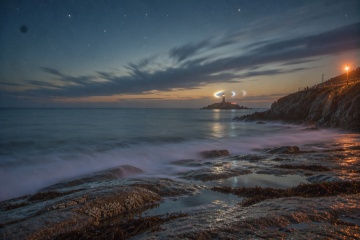
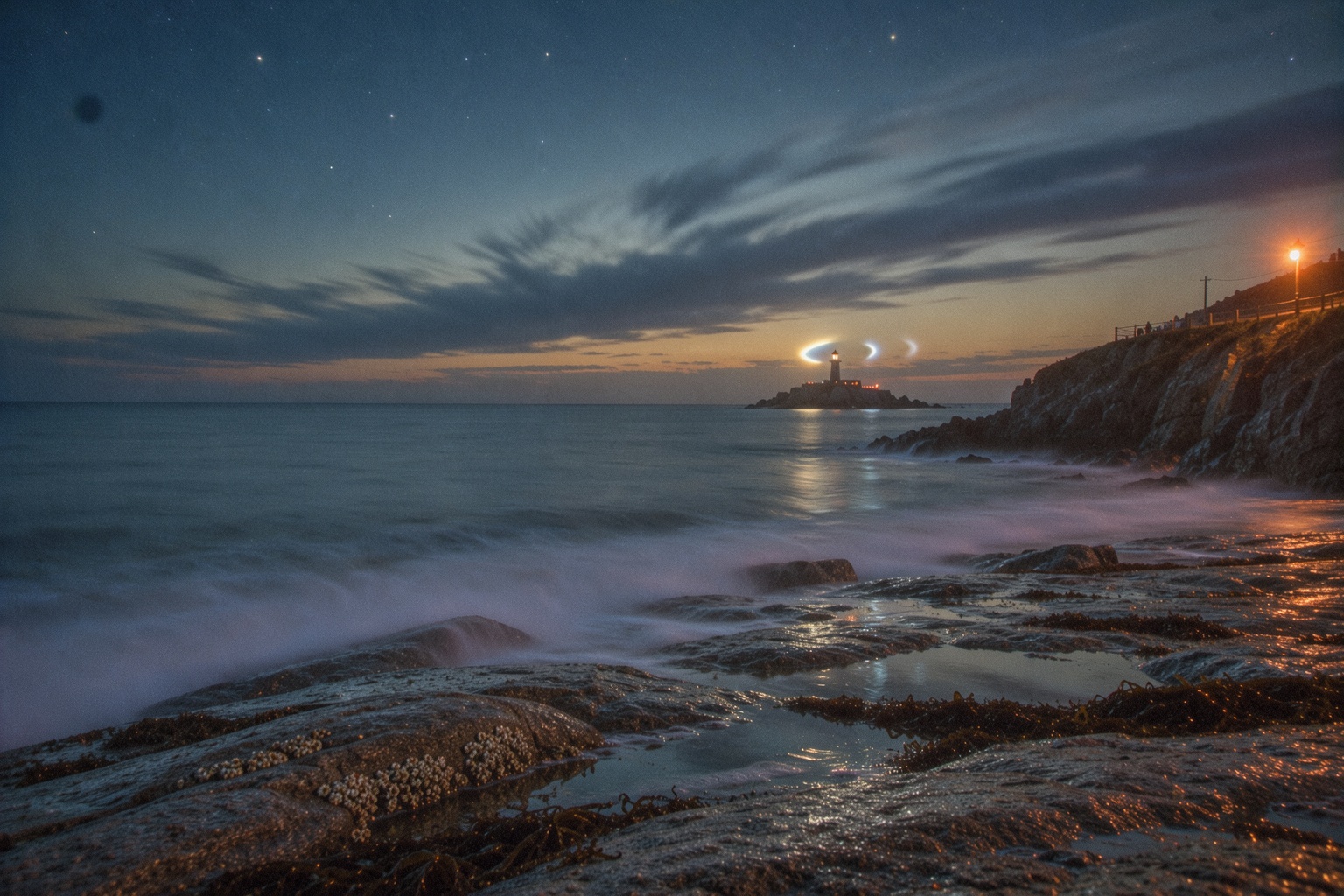
A single thirty-second long-exposure landscape photograph of a rocky coastline at blue hour, made on a full-frame body with a 24mm lens at f/11, ISO 50, on a locked-off tripod with mirror lock-up and a six-stop neutral density filter. There is no camera movement anywhere in the frame: every static element is critically sharp, which is what makes the moving elements read as genuinely blurred rather than soft.
The sea has been smoothed by the exposure into a flat, milky, almost featureless plane of pale grey-blue, with the incoming swells reduced to soft luminous veils that drag across the foreground rocks in long streaks following the direction of the water's travel. Where the water retreats over the rock shelf it leaves thin sheet-like highlights. The receding foam around the base of the rocks has dissolved into a smooth bright haze with no discrete bubbles or edges. In the sky, low cloud has streaked horizontally into long even bands pulled toward the right by the prevailing wind, while the higher, slower cirrus has only smeared slightly. The overall sky is a deep gradient from near-navy at the top to a pale desaturated amber-grey along the horizon, where the last of the sunset sits below the visible sun.
A lighthouse about a kilometre offshore shows its rotating beacon caught mid-sweep: a bright partial arc of light on the seaward side plus two or three fainter detached ghost images where the beam pointed during the exposure, rather than a single steady dot. A handful of the brightest stars have just begun to register as clean round points with no trailing, since thirty seconds is far too short to draw arcs. Along the cliff path at the right edge, a single sodium vapour streetlamp contaminates the otherwise cool scene with a small pool of warm orange light and a visible orange halo of atmospheric scatter around it, and that warm cast creeps faintly onto the nearest rock face.
Because the exposure is long, the deep shadow areas carry fine luminance noise and a slight magenta-green colour cast typical of a sensor held open for half a minute. Diffraction at f/11 has taken a little bite out of the finest detail, so distant rigging and rock texture are slightly softened without being out of focus. There is gentle optical vignetting darkening all four corners, mild lateral chromatic aberration fringing the horizon line at the extreme edges, and a very faint circular dust shadow in the upper left sky from a speck on the sensor. The foreground granite is rendered with real geological specificity: rough crystalline grain, wet dark patches where water still clings, coarse barnacle clusters, tangles of dried kelp, and small tide pools that held their surface still enough to mirror the sky. Neutral, restrained colour grading that keeps the blue hour genuinely blue rather than pushing it toward teal, with honest contrast and no added glow, no star filter, and no sky replacement.