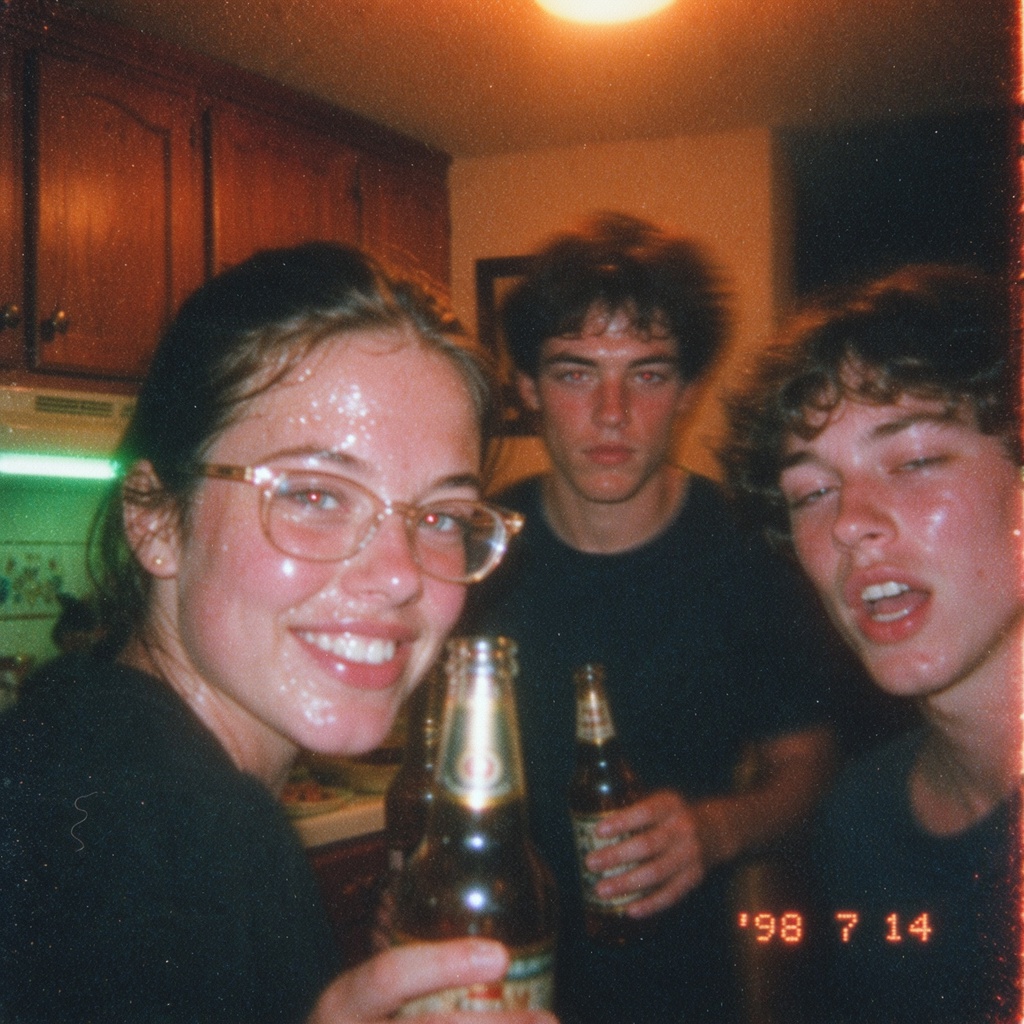
A badly-made snapshot from a cheap 1998 compact film camera with its built-in flash fired, shot at roughly 38mm, a fixed f/8 aperture, 1/60s, on ISO 400 colour negative film. Four young adults are crowded into a small kitchen at a house party at about one in the morning, squeezed close to the lens because the camera's flash has almost no reach.
The flash is the defining feature and it behaves exactly like a tiny frontal on-camera unit. It lights the two nearest people correctly, overexposes the face of the woman closest to the lens so her forehead and cheekbone clip to white, and then runs out of energy: the man behind them is visibly underexposed, and the back wall only three metres away has already dropped to a murky brown while the hallway beyond it is pure black. Inverse-square falloff, not artistic choice. The light is hard and completely flat, killing every bit of facial modelling, and each person casts a small crisp shadow directly behind them onto the wall, slightly offset and doubled where the ceiling light also contributes. There are hard white specular hotspots on the nearest cheekbones, on the bridge of a pair of glasses, on a sweating forehead, on wet teeth and on the glossy surface of a beer bottle held up toward the camera. One man's eyes show faint red-eye, the retinal reflection of the flash sitting close to the lens axis.
The colour balance is wrong in the specific way direct flash at night always is. The flash is roughly daylight-balanced at 5500K, so the people it reaches look neutral to slightly cool, while the room's tungsten bulbs at about 2800K render everything the flash did not reach in a heavy orange-amber cast. The two colour temperatures meet visibly down the centre of the frame. A greenish fluorescent strip over the sink adds a third, sickly cast on the left edge.
The framing and focus are imperfect. The camera was held slightly too low and tilted a few degrees, so the ceiling is cropped and the verticals lean. The youngest person on the right is cut off at the shoulder and mid-word, mouth open and eyes half-closed. One man at the back moved during the 1/60s exposure and his raised arm carries obvious directional motion blur while his torso stays sharp. Focus has locked on the nearest face, leaving the two people behind it slightly soft. There is a smear of a fingerprint on the lens producing a faint hazy bloom around the brightest highlights, plus a couple of grains of dust and one stray hair caught in the gate showing as a dark squiggle in the lower left.
The medium is unmistakably cheap colour negative film: coarse visible grain throughout, most pronounced in the underexposed shadow areas; muted, slightly shifted colours with weak reds and a green cast in the midtones; compressed highlight detail; soft overall acuity from a plastic two-element lens; and heavy halation, where the brightest flash speculars bleed into fuzzy orange-red halos on the surrounding emulsion. Slight light leak along the right edge of the frame. The print has been scanned and shows faint dust and a mild yellow shift. In the bottom right corner, burned into the emulsion by the camera's date back in dim orange seven-segment numerals, reads:
"'98 7 14"