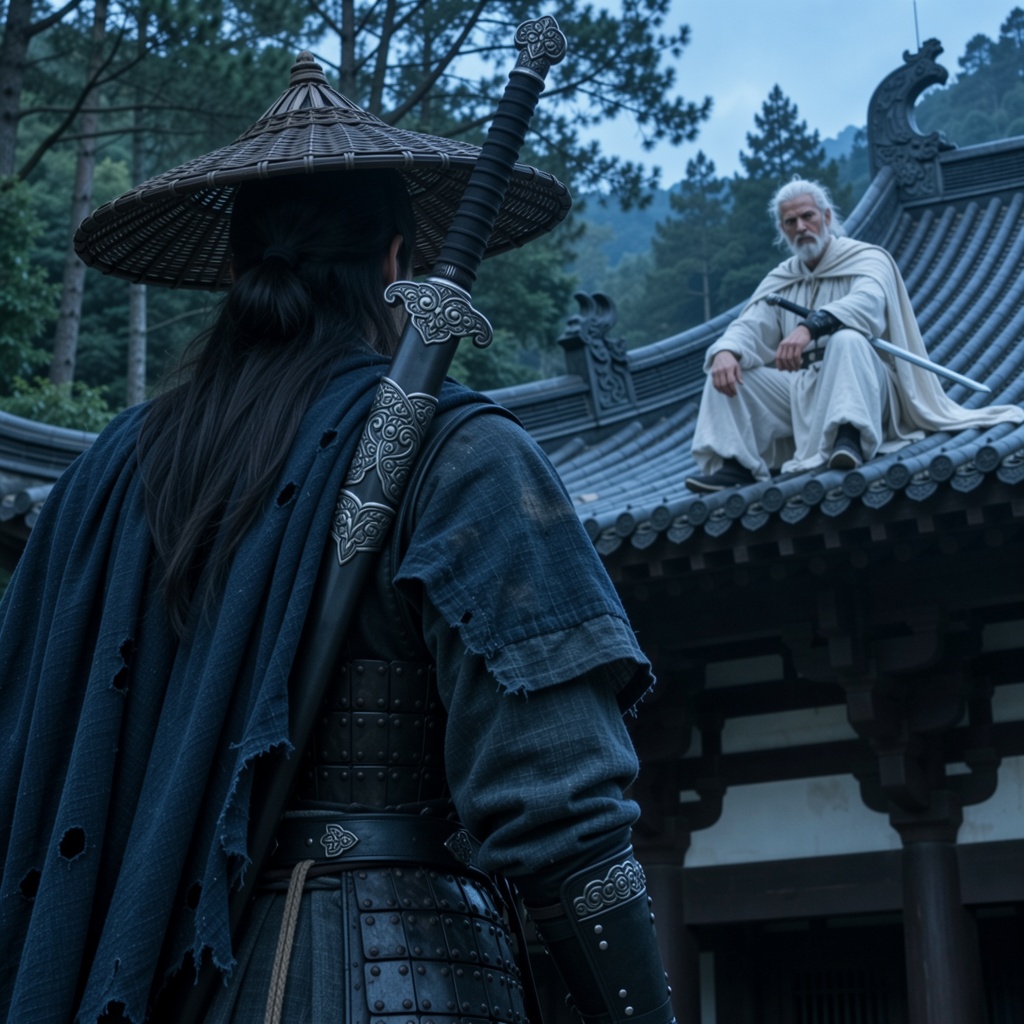
The main subject is a lone ***** Chinese male warrior viewed from behind, positioned prominently in the left half of the composition and occupying approximately 48 percent of the image height. His body faces forward toward a distant traditional Chinese temple, with his head slightly inclined toward the structure. His facial features remain hidden from the rear perspective, emphasizing his anonymous, enigmatic presence. Long, straight, dark charcoal-black hair is gathered into a low traditional Chinese warrior's knot, with individual strands and loose sections falling over his upper back. He wears a broad, dark Chinese woven bamboo conical hat with an irregular, gently undulating brim, a slightly raised central crown, and visible layered bamboo weaving texture. A long Chinese jian straight sword is secured diagonally across his back, its dark lacquered scabbard rising from the center of his upper back and extending beyond the top edge of the frame. The sword features an intricately sculpted silver-black metal guard with elaborate traditional Chinese cloud patterns, interlocking floral motifs, curling scrollwork, fine engraved grooves, polished raised edges, and small reflective highlights. The weapon's wrapped handle displays tightly wound dark cord with a subtle ribbed texture.
His clothing consists of layered, weathered ancient Chinese warrior garments and a tattered dark indigo-gray travel cloak. The outer garment drapes heavily across his shoulders and upper arms, with irregular torn edges, frayed threads, elongated fabric strips, small punctures, abrasion marks, and scattered dark stains. The fabric displays realistic coarse fibers, dampened patches, deep creases, and subtle directional highlights. Beneath the cloak, overlapping black leather and dark iron armor plates inspired by historical Chinese lamellar armor protect his torso and waist. The armor includes segmented horizontal bands, overlapping rectangular metal plates, reinforced straps, embossed metal fittings, small circular rivets, braided cords, and ornate Chinese-style buckles. His left arm extends diagonally downward and outward toward the lower-left corner, partially disappearing beyond the frame, while his right arm hangs close to his body beneath the draped cloak. His shoulders are squared yet relaxed, and his upright stance communicates quiet determination, disciplined restraint, and readiness for confrontation. The character's silhouette remains sharply defined against the lighter atmospheric background.
The setting is an ancient Chinese temple or fortified shrine surrounded by a dense forest. A monumental traditional Chinese temple roof stretches horizontally across the middle and right portions of the frame. Its broad roofline features traditional Chinese hip-and-gable architecture, layered dark wooden eaves, closely spaced curved ceramic roof tiles, repeating parallel ridges, and elegantly upturned corners. The roof surface is predominantly charcoal black and blue-gray, with narrow silver-blue highlights tracing the exposed tile edges. Above the main roof, traditional Chinese ornamental ridge creatures, chiwen-style roof ornaments, and sculpted mythical beasts emerge against the misty forest canopy, Dark wooden beams, traditional Chinese dougong bracket systems, and shadowed structural elements beneath the eaves create strong horizontal lines and a sense of architectural mass. Tall trees rise behind the building, with slender trunks, tangled branches, and dense clusters of muted green foliage receding into the distance. The forest fills the upper-left and upper-middle background, creating an intricate natural frame around the temple.
On the main ridge of the traditional Chinese temple roof, a second Chinese warrior sitting calmly on the raised roof ridge, facing the camera in a three-quarter view. He is a rugged middle-aged warrior with no hat, his weathered face stern and expressive, with short tousled white hair and a full, neatly kept white beard framing his strong jaw. His sharp, piercing eyes focus intensely into the distance with a vigilant, battle-hardened gaze. He wears layered white ancient Chinese robes with flowing sleeves, a weathered white outer cloak, and subtle fabric folds moving gently in the mountain wind. He wears no armor, only simple, elegant white garments with realistic woven fabric texture and natural creases. A Chinese jian straight sword is secured at his waist, with one hand resting firmly on the sword hilt, ready to draw at any moment. He sits in a composed, balanced posture, with one knee slightly raised and the other leg naturally bent along the roof ridge. Soft, cold moonlight illuminates his white hair, beard, weathered facial features, and white clothing, creating a striking contrast against the dark blue-gray temple roof and misty forest. His face is clearly visible, with realistic skin texture, fine wrinkles, and a stern, intimidating expression. He remains smaller than the main foreground warrior, with realistic proportions and accurate perspective. His pose conveys quiet menace, controlled confidence, and readiness for confrontation.
Use a restrained, predominantly cold color palette consisting of midnight navy, slate blue, desaturated cyan, charcoal black, muted forest green, and subtle steel-gray highlights. The upper background is filled with layered blue-gray atmospheric haze, while the temple roof and foreground character remain substantially darker. Soft, diffused moonlight or overcast twilight illumination enters from the upper-right background, producing a cool backlight that traces the warrior's right shoulder, the frayed edge of his cloak, the contours of the sword fittings, and the exposed roof tiles. Gentle volumetric light filters through the forest canopy, creating faint, visible shafts of blue-white illumination between distant tree trunks. Ambient occlusion deepens the shadows beneath the hat brim, between the armor plates, inside the cloak folds, and under the architectural eaves. Specular highlights remain restrained and physically plausible, emphasizing wet-looking metal, worn lacquer, textured fabric, and weathered timber.
The composition uses a low, slightly upward-looking rear three-quarter camera angle, with the Chinese warrior dominating the left foreground and the temple occupying the middle and right background. The broad bamboo hat forms a strong horizontal silhouette in the upper-left quadrant, while the diagonal Chinese sword handle creates a contrasting upward line that leads toward the top edge. The temple roof extends from the center toward the right edge, establishing a powerful architectural counterbalance to the warrior. Preserve clear separation between the foreground character, middle-ground roof, and distant forest through layered atmospheric perspective.