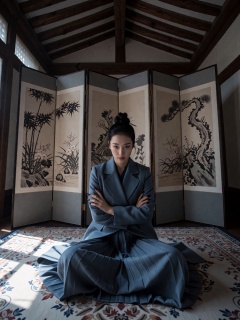
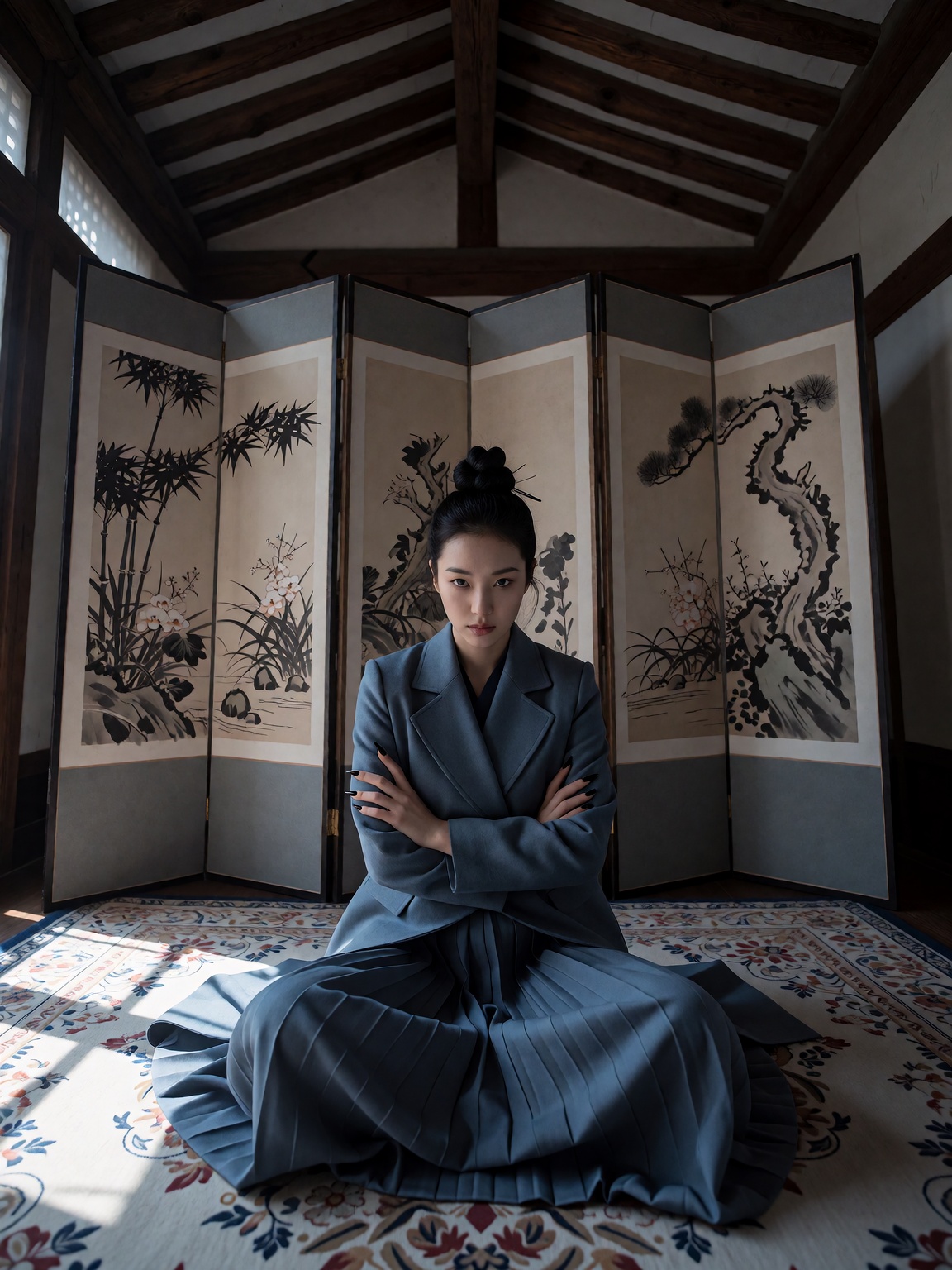
The korean woman sits cross-legged on an ornate rug, her arms folded tightly across her chest as she gazes directly into the frame with unblinking eyes—her expression neutral yet commanding. Behind her looms a six-panel folding screen adorned in traditional ink-wash paintings depicting bamboo, orchids, and gnarled trees, each panel framed by muted gray borders that recede subtly into shadow. The ceiling above is composed of dark wooden beams arranged diagonally, casting deep shadows against the pale walls. A single shaft of natural light slices through a high window to the left, illuminating only part of the floor and creating stark contrasts between bright patches and dense gloom. Her attire—a structured blue coat over a pleated skirt—is rendered in cool tones that harmonize with the room’s subdued palette, while her black hair is styled in a tight bun atop her head, adding formality to her posture. She wears long nails painted glossy black, which catch faint highlights from the sunbeam. The camera holds at eye level, slightly tilted upward due to its wide-angle distortion, emphasizing both her presence and the architectural curvature around her. Depth-of-field remains shallow, blurring edges beyond immediate focus while keeping her face sharp amidst surrounding darkness. There are no visible movement cues or wind currents—the air feels static, suspended within this space where time appears frozen under theatrical illumination. The overall tone suggests reverence mixed with quiet tension, as if documenting a moment caught between tradition and modernity.